Key Takeaways: This study investigated whether post-discharge outcomes of Medicare patients with chronic wounds were better for clinics with high risk-adjusted healing rates than for clinics with low rates. In this observational study, the incidence of wound recurrence and gangrene was significantly lower with adjusted hazard ratios of 0.82 and 0.62, respectively, and the incidence of sepsis and amputation numerically…
Learn More
Key Takeaways: Early change in wound size is the dominant predictor of healing. Machine learning substantially outperforms traditional regression models. Predictions become highly accurate by weeks 4–5 of treatment (AUC 0.90–0.92). The model could enable earlier intervention for wounds unlikely to heal, improving outcomes and resource utilization. Read the full publication: prediction of a healing trajectory of chronic wounds using a…
Learn More
Key Takeaways: Continuity of care is the strongest predictor of better healing, and most hospitals struggle to deliver it. Evidence‑based practices, especially debridement procedures separate high performers from low performers. Socioeconomic disadvantage does not reduce outcomes if continuity and quality of care are strong. read the full publication: association of wound healing with quality and continuity of care and sociodemographic…
Learn More
Key Takeaways: Outpatient wound clinics saw significantly fewer patients during the pandemic, especially early in 2020. Despite treating fewer patients and adapting to pandemic restrictions, clinics maintained key quality metrics. Wound care centers implemented new infection-control procedures and workflow changes that allowed them to continue providing effective care. Read the full publication: Outpatient wound clinics during covid-19…
Learn More
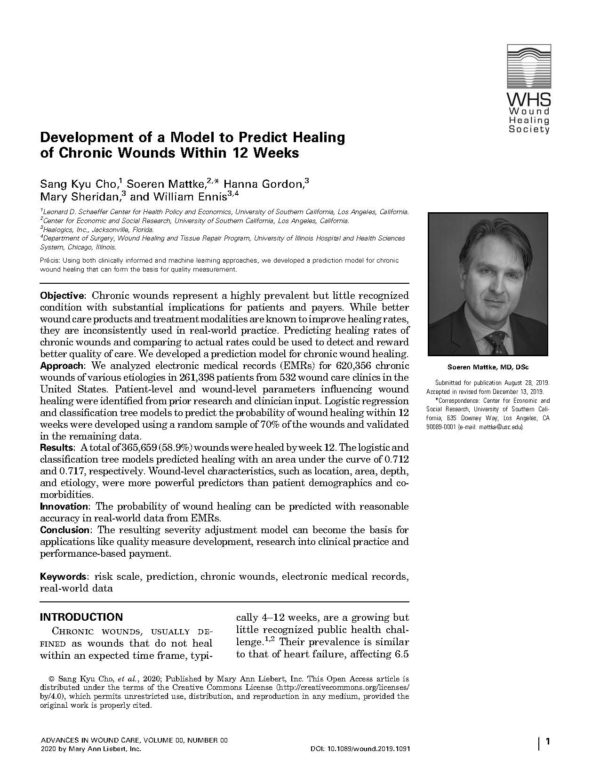
Researchers from the University of Southern California (USC) in partnership with Healogics have recently produced a predictive model to identify wounds most likely to heal within 12 weeks. Unlike other models that have been previously published, this model utilized EMR data from over 600,000 wounds, allowing for highly predictive classification across a variety of wound types. Findings from this model also indicated that a wound’s characteristics at initial presentation, such as area, depth, and location, are far more powerful than the patient demographics or comorbidities in determining whether a wound will heal.
Learn More
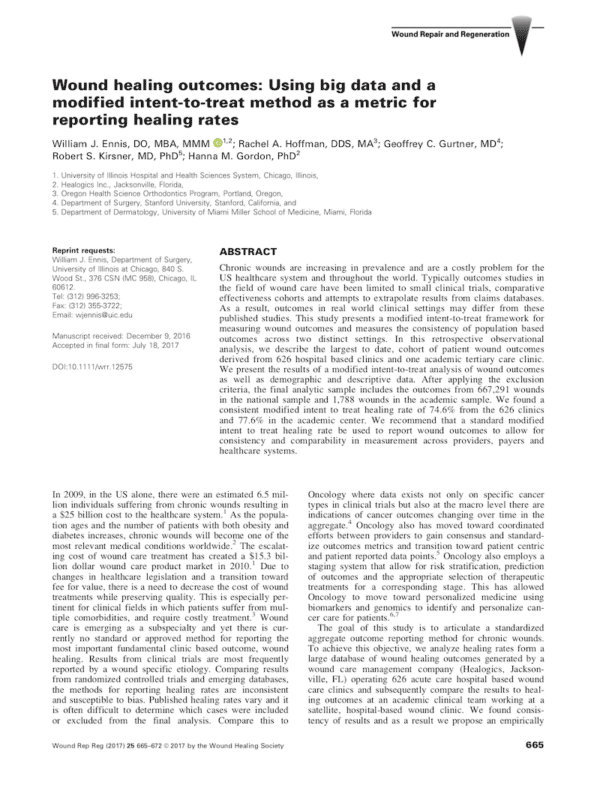
This study presents a modified intent-to-treat framework for measuring wound outcomes and measures the consistency of population based outcomes across two distinct settings. In this retrospective observational analysis, we describe the largest to date, cohort of patient wound outcomes derived from 626 hospital based clinics and one academic tertiary care clinic. We present the results of a modified intent-to-treat analysis of wound outcomes as well as demographic and descriptive data.
Learn More
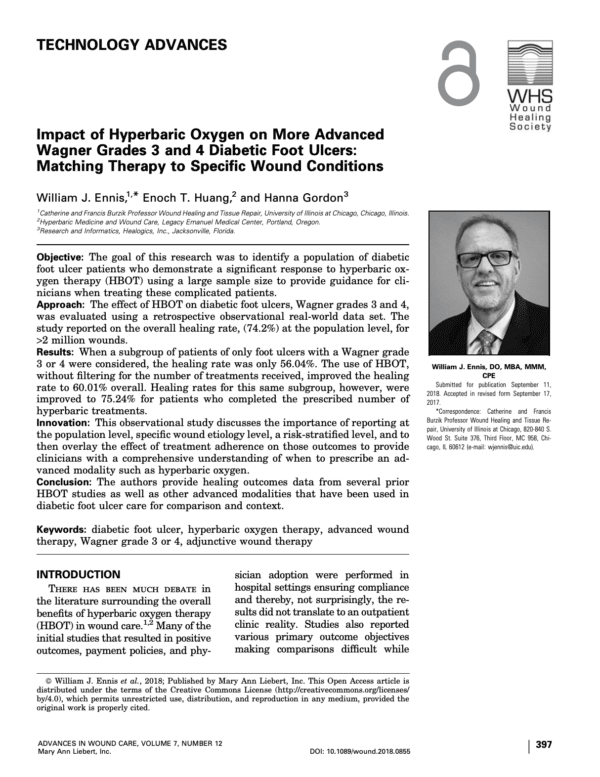
The goal of this research was to identify a population of diabetic foot ulcer patients who demonstrate a significant response to hyperbaric oxygen therapy (HBOT) using a large sample size to provide guidance for clinicians when treating these complicated patients.
Learn More